

The Operational AI Maturity Model: From Fragmented to Governed
A map of the four stages every organization moves through as it learns to run AI as one system, and the specific opportunity waiting at each one.
Most conversations about AI maturity ask the wrong question. They ask how much AI an organization uses: how many tools, how many seats, how many agents, how many pilots underway. That number turns out to tell you very little. Plenty of organizations using a great deal of AI are getting almost nothing back, and a few using far less are quietly pulling ahead. MIT's widely cited 2025 NANDA study found that the large majority of enterprise AI pilots produced no measurable impact on the bottom line, even as investment climbed. The difference between the winners and everyone else was rarely the model. It was coordination.
So this model measures something more useful than volume. It measures the degree to which AI, people, and your existing systems work against one shared plan, under one set of controls. That is what separates an organization that owns its AI from one that is merely surrounded by it.
Why a map helps
When something feels out of hand, the first relief is not a solution. It is a location. Most leaders sense that their AI footprint has outgrown their ability to coordinate it, but they cannot say precisely where they stand, or what good would even look like from here. Naming the stages does two things. It replaces a vague unease with a specific position, and it turns "we are behind" into "here is the next move."
No stage in this model is a failure. Each is a normal place to be, and almost every organization is somewhere in the first two stages today. That is not a cause for worry. It means almost every organization has real, recoverable upside directly in front of it.
The five things that mature together
Across every stage, the same five dimensions move. We use them as the lens because they are the five places coordination tends to break first.
- Sprawl and fragmentation. How many AI tools, models, and agents are in use, and whether anyone can see them all. The 2026 Salesforce Connectivity Benchmark found the average organization already runs a dozen or more AI agents, with about half operating in isolation from one another.
- Accountability. Whether AI-influenced decisions have a clear owner and an audit trail.
- Cost and spend visibility. Whether AI spend is one attributable budget or many invisible ones.
- Confidence versus readiness. Whether stated confidence in the AI program is matched by the controls to back it up.
- Lock-in and flexibility. Whether the organization can change models or providers without a rebuild.
A note on the fourth dimension, because it is the most common pattern we see. Confidence almost always runs ahead of readiness. In 2026, Gartner noted that only a small fraction of organizations feel adequately prepared to govern AI agents at the scale they are heading toward, even as adoption accelerates. The gap between how ready a team feels and how ready its systems actually are is quiet, expensive, and very fixable. Each stage below closes a little more of it.
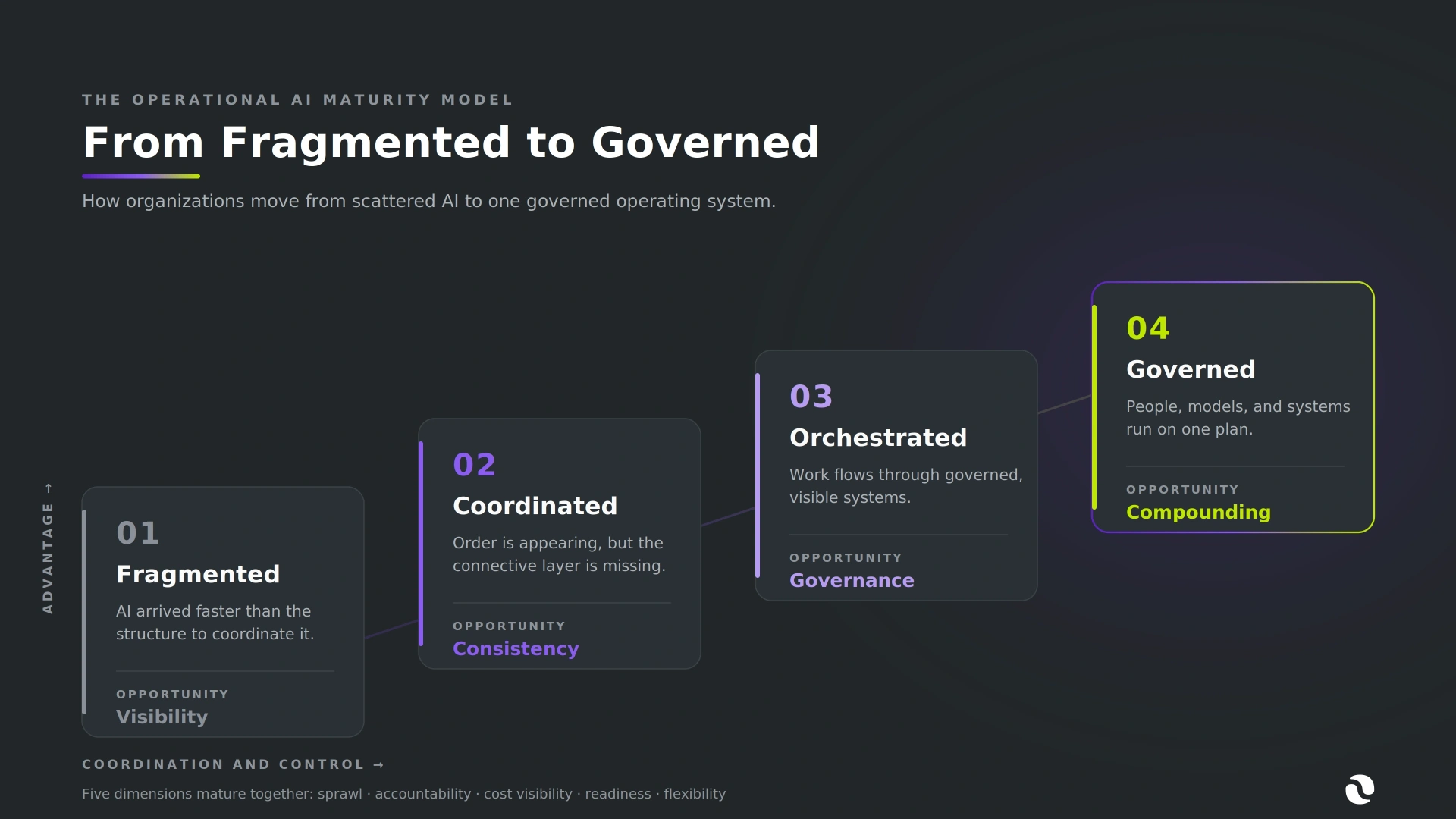
Stage 1: Fragmented
AI arrived faster than the structure to coordinate it. This is the most common place to be, and it is not a failure. It is the normal first chapter. Teams adopted good tools on their own initiative because the need was real and the tools worked. Nobody did anything wrong. The structure simply has not caught up yet.
How you know you are here. Many tools, adopted team by team or by individuals, often more than anyone can confidently count. No clear owner when an AI-assisted decision goes wrong. Spend scattered across cards, contracts, and teams, hard to attribute to anything. Little or no audit trail. Models chosen by default rather than by design.
The characteristic risk. Duplicated effort, invisible cost, and the slow accumulation of decisions that nobody owns. This is where agent sprawl lives. A 2026 OutSystems survey of nearly 1,900 IT leaders found that the overwhelming majority say sprawl is increasing complexity, technical debt, and security risk, while only a small minority have any centralized way to manage it.
Stage 2: Coordinated
Order has started to appear. Adoption is no longer purely ad hoc. Some teams follow shared practices, some tools are sanctioned, some review exists. You are further along than most. What is missing is the connective layer that turns coordinated teams into a single system.
How you know you are here. Tools are adopted with some oversight rather than entirely on their own. Accountability exists, but informally, and it depends on who you ask. There are a few budgets rather than one, or rather than countless. The audit trail is partial. Model flexibility is beginning to be discussed, even if it is not yet designed for.
The characteristic risk. Islands. Good practice in one corner does not reach the next, so the organization keeps solving the same problem several times over and improves more slowly than it should.
Stage 3: Orchestrated
A strong position, and one few organizations reach. Work moves through structured, visible workflows. AI is part of how the business runs rather than a set of side experiments. People and AI act inside the same system, with owners and checkpoints, and you can see work move from start to finish.
How you know you are here. Adoption is central or well governed. Ownership is clear and the audit trail is genuinely usable. There is one mostly unified, attributable budget. Confidence is broadly matched by readiness. Model choices are deliberate.
The characteristic risk. Treating governance as a brake. Organizations here sometimes use their controls only to review and slow things down, when those same controls could be letting them move faster.
Stage 4: Governed
The leading edge. AI, people, and systems work against one plan, under one set of controls, with the freedom to adapt as the technology shifts. The operating model itself has become an asset.
How you know you are here. AI is coordinated centrally by design. Every action is owned and logged by default. There is one governed budget where every unit of consumption is attributable. Confidence and readiness are aligned. Model portability is deliberate and actively maintained.
The characteristic risk. Complacency, and quietly letting portability lapse as the market moves underneath you.
How to find your stage
You can usually place yourself just by reading the four descriptions above and noticing which scene sounds most like a normal Tuesday. If you want a more precise read across all five dimensions, the Operational AI Readiness Assessment places your organization in one of these same four stages. It returns your stage, a conservative estimate of what the current gaps are costing you, and the specific next moves for exactly where you stand.
The through-line
The point of a maturity model is not to make anyone feel behind. Almost every organization is somewhere in the first two stages right now, which is precisely why almost every organization has real, recoverable value waiting in front of it. The goal is not to leap to Governed overnight. It is to know where you stand and to make the next move deliberately, in order.
Maturity here is not about using more AI. It is about coordinating the AI you already have, so that people, models, and systems finally work against one plan.
If you want to see how Opal helps organizations move from fragmented to governed under one set of controls, you can Get started or Book a demo.