Guardrails

Build with control and confidence.

Guardrails help Opal enforce policy, quality, and approval requirements so AI-driven work stays aligned with your business rules.

Guardrails · enforcinglive
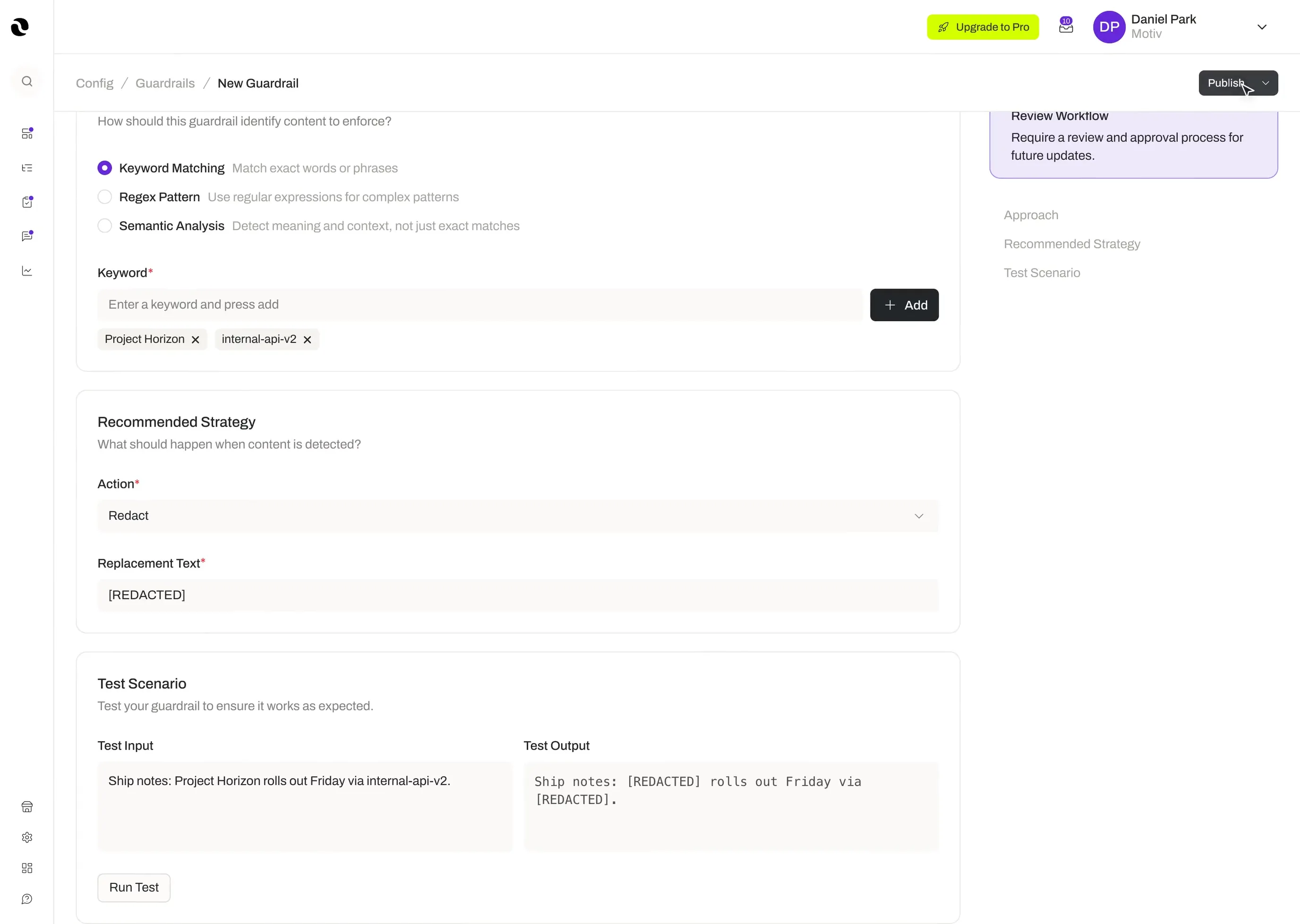
PII redaction
3 redacted
Customer emailed about order .
emailorder#phone
Policy check
passed · 0.18
toxicity
0.08
off-topic
0.22
jailbreak
0.04
Blocked this week
247 requests
prompt injection
112
off-policy reply
84
pii leak
51
PII redaction
3 redacted
Customer emailed about order .
emailorder#phone
Why it matters

Reliable outputs and safer automation come before scale.

Teams need reliable outputs, safer automation, and stronger trust before AI can scale across sensitive workflows.

Trust before scale
How it works

From setup to live workflow.

  1. Step 01

    Define the rule

    Set quality, content, or policy criteria that AI work must meet.

  2. Step 02

    Attach to a flow

    Apply the guardrail at the right step. Before action, before send, or before publish.

  3. Step 03

    Route exceptions

    Send borderline outputs to a person for review or escalation.

  4. Step 04

    Track and tune

    Watch how often a guardrail fires and refine the rule over time.

What it does

What Guardrails help you do.

  • 01Apply quality thresholds and review rules
  • 02Require approvals at sensitive points in a workflow
  • 03Restrict certain actions or outputs
  • 04Create escalation paths for exceptions
  • 05Maintain standards across repeated AI use cases
Outcomes

What teams actually see.

01 / Outcome

Trusted AI outputs

Teams trust what ships because it passed your standards first.

02 / Outcome

Safer automation

Sensitive steps require approval. By default, not by exception.

03 / Outcome

Adaptive as you learn

Guardrails evolve as your use cases mature.

Build on Opal

Build with stronger safeguards from day one.

See how Opal helps you operationalize AI without giving up standards or oversight.