

The Operational AI Layer: Why Adoption Stalls on Accountability, Not Capability
Most enterprises do not have an AI capability problem. They have an accountability problem. This is the case for treating the layer that governs your AI as the same layer that compounds your advantage.
The paradox every leader is living
Spend on AI has never been higher, and confidence in it has never been lower. The models are extraordinary and getting better every quarter. The tools are in everyone's hands. And yet, for most organizations, the line that connects all of that activity to a measurable business result is faint or missing entirely.
This is not a quiet suspicion anymore. It is the dominant finding of the period. MIT's widely cited 2025 NANDA study found that the large majority of enterprise AI pilots produced no measurable impact on the bottom line, even as investment climbed. The instinctive reading is that the technology has not arrived yet, that the next model will close the gap. The evidence points the other way. Organizations using nearly identical models are getting wildly different results, which means the variable that matters is not the model. It is what surrounds it.
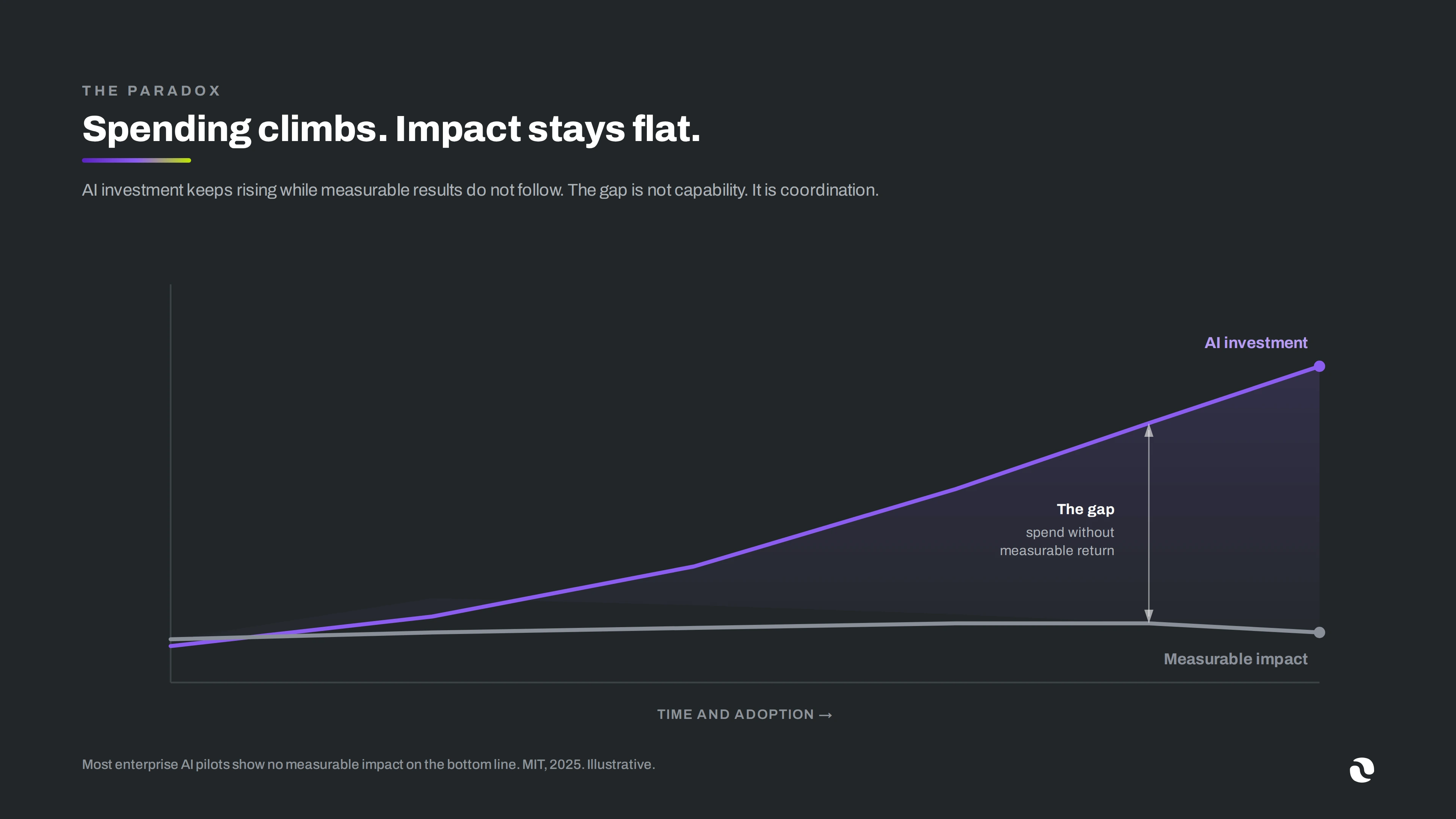
The uncomfortable truth underneath the numbers is this: AI adoption does not stall on capability. It stalls on accountability. The pilots that fail rarely fail because the model could not do the task. They fail because no one could say who owned the output, what it cost, whether it could be trusted, or how it would scale beyond the one team that built it. Capability is abundant. Accountability is scarce. And the organizations that close that gap first will not just avoid the failures. They will turn the very thing everyone else fears into their advantage.
How the gap actually forms
No one decides to build an ungoverned AI estate. It accumulates, one reasonable decision at a time.
A marketing team adopts a tool that writes well. Support stands up a few assistants that resolve tickets faster. Engineering wires a model into a workflow. Finance quietly runs analysis through whatever is at hand. Each of these choices is sensible in isolation. None of them is coordinated with the others. Within a year, the organization is running far more AI than anyone can see, owned by no one in particular, billed to a dozen different budgets, and governed by hope.
The market has a name for the visible symptom now. It is agent sprawl, and it is arriving fast. The 2026 Salesforce Connectivity Benchmark found the average organization already runs a dozen or more AI agents, with about half operating in isolation from one another. Gartner has projected that within a few years the typical large enterprise will run AI agents not in the dozens but in the tens of thousands. And readiness is not keeping pace. A 2026 OutSystems survey of nearly 1,900 IT leaders found that the overwhelming majority say sprawl is already increasing complexity, technical debt, and security risk, while only a small minority have any centralized way to manage it.
Sprawl is the part you can see. The deeper problem is what sprawl is a symptom of: there is no layer at which it all comes together. The models sit at one level. The tools sit at another. The people doing the work sit at a third. Nothing holds the shared plan, the shared controls, or the shared memory of what was done and why. The work is happening. The accountability for it has nowhere to live.
Why this is an accountability problem, not a tooling problem
It is tempting to respond to sprawl the way organizations responded to earlier waves of tool proliferation: consolidate, standardize, pick a winner, lock it down. That instinct is not wrong, but it aims at the wrong target. The problem is not that there are too many tools. The problem is that there is no answer to a set of questions that get harder every month:
When an AI-assisted decision goes wrong, who owns it? When spend climbs, can anyone attribute it to an outcome? When a regulator, an auditor, or a board member asks how a decision was made, is there a record? When the best model for a job changes next quarter, can you move without rebuilding everything you have come to depend on?
These are not questions about capability. Every one of them is a question about accountability, and none of them is answered by a better model or a longer list of approved tools. They are answered by structure: a place where ownership is assigned, where actions are logged by default, where spend is visible and attributable, and where the plan that people and AI are working against is shared rather than scattered.
This is why the framing matters. If you believe adoption stalls on capability, you wait for the next model and keep piloting. If you understand that it stalls on accountability, you build the one thing that actually moves the result, and you stop waiting.
The operational AI layer
The missing structure has a shape, and it sits in a specific place. It is not another model, and it is not another application. It is a layer above your tools and models and below your strategy, where people, AI agents, and existing systems all work against one shared plan under one set of controls. Call it the operational AI layer.
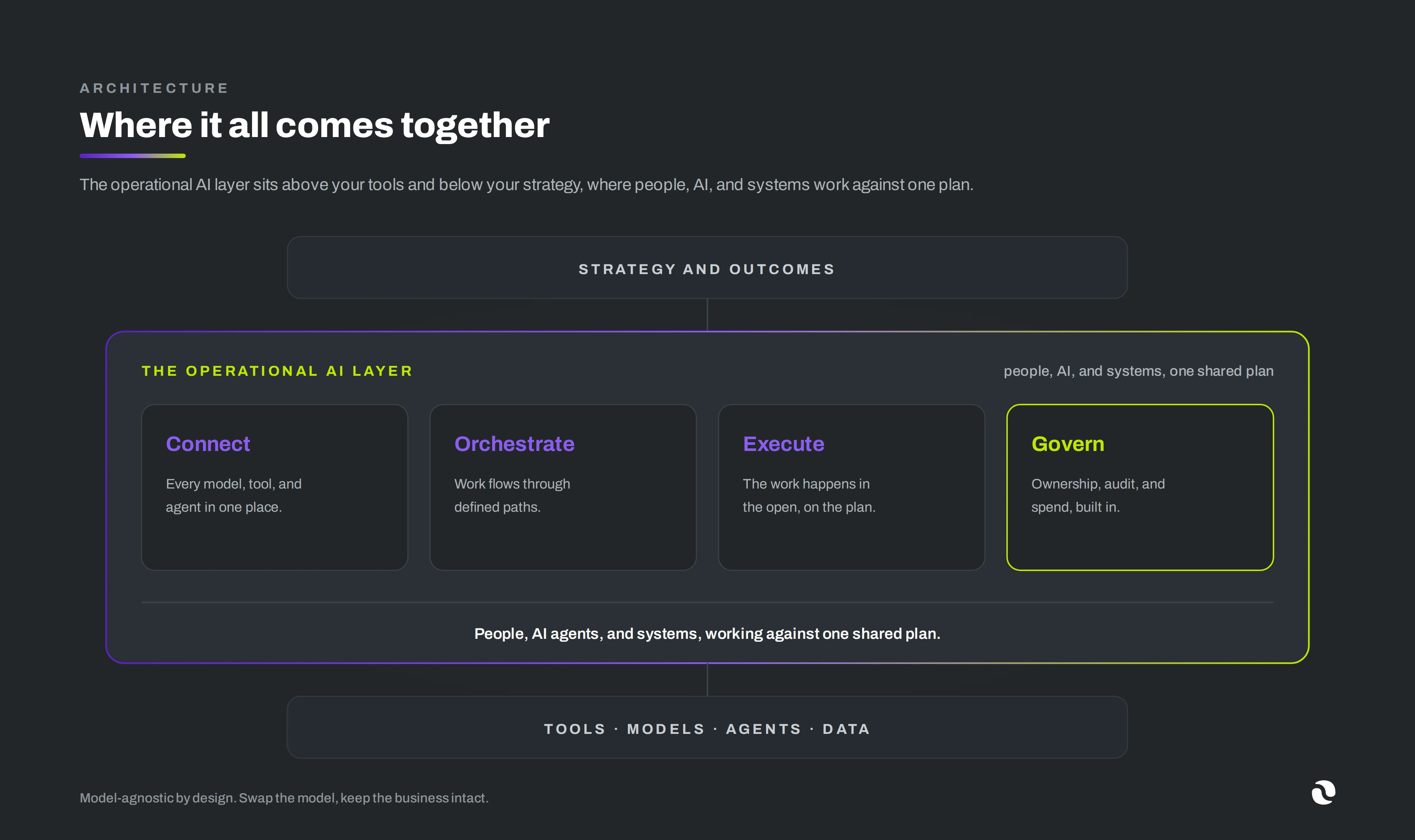
A useful way to see it is in four functions that have to live somewhere, and today usually live nowhere:
It connects. Every model, tool, data source, and agent plugs into one place rather than into a hundred private integrations, so the organization can finally see its whole AI estate at once.
It orchestrates. Work flows through defined paths where people and AI hand off to each other deliberately, rather than through ad hoc prompts and copied output. Orchestration is the difference between automating a task and coordinating an outcome, and it is where results actually compound.
It executes. The work gets done in the open, against the shared plan, with every step visible rather than buried inside a tool only one team can see.
It governs. Ownership, audit trails, guardrails, and spend control are properties of the layer itself, applied to everything that runs through it, rather than features bolted onto each tool one at a time.
The important claim is not that these four functions are novel. It is that they belong together, in one layer, applied uniformly. The moment governance lives in the same place as execution, accountability stops being a document you write after the fact and becomes a property of how work happens. That is the shift.
Turning each risk into an advantage
Here is the part that changes the conversation. Every risk an executive is managing defensively in this moment is, seen from the operational layer, a capability waiting to be built. The same structure that contains the downside creates the upside. They are not two projects. They are one.
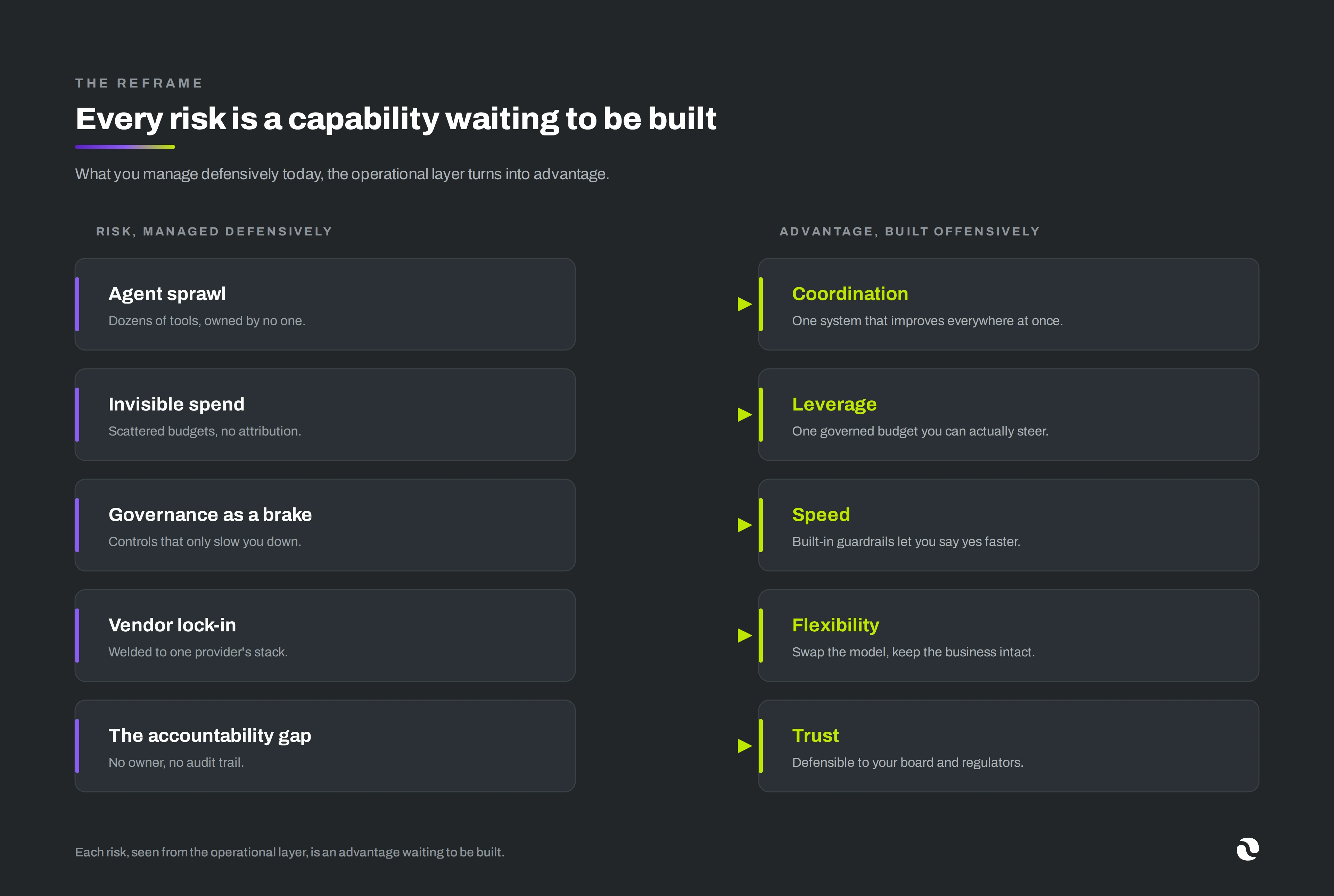
Sprawl, contained, becomes coordination. The map of where AI multiplied across your organization is also a map of where the work actually wants to flow. Bring it under one roof and you do not just reduce risk, you gain a coordinated system that improves everywhere at once instead of in isolated pockets.
Cost, made visible, becomes leverage. Ungoverned spend is pure downside. The same spend, pulled into one attributable budget where every unit of consumption is tracked, becomes a lever you can actually pull, with the duplication retired and the highest-value work funded deliberately.
Governance, built in, becomes speed. The organizations that treat controls as a brake move slowly and defensively. The ones that build governance into the layer can say yes faster, because the guardrails are already there and the audit trail writes itself. Defensibility and velocity stop being a trade-off.
Lock-in, refused, becomes flexibility. This is the sharpest one, and the one most vendors will not say out loud. The fastest growing dependency in enterprise AI is not the model. It is the orchestration layer itself. If your agents, workflows, and governance are welded to one vendor's proprietary system, switching costs compound at every level. An operational layer that is model-agnostic by design turns that trap into its opposite. You can swap the model and keep the business intact, which means you keep your negotiating leverage and your freedom to adopt whatever is best next.
The accountability gap, closed, becomes trust. When you can show who owns each AI decision and how it was made, you earn something your competitors cannot fake: the confidence of your board, your regulators, your customers, and your own people. Deloitte has argued that organizations which fail to design their accountability model will soon find it designed for them, by an audit, a regulation, or a public failure. The organizations that design it first turn a looming liability into a mark of seriousness.
What this asks of a leader
None of this requires waiting for a better model, and none of it starts with a year-long platform program. It starts with a change in where you look.
The first move is visibility. You cannot govern, fund, or improve what you cannot see, so the first act is simply to inventory what is already running: every tool, every agent, every model, every budget it touches. That exercise alone almost always retires obvious duplication and surfaces the shape of the problem.
The second move is ownership. Name a single point of accountability for AI decisions, not to slow anyone down, but so that when something needs deciding, someone is positioned to decide it.
The third move is to choose one workflow and run it through the operational layer end to end, so the organization has a working proof and a template to extend, rather than a slide about a future state.
And underneath all of it is one principle worth protecting from the very start: stay portable. Preserve your ability to change your mind about any model or vendor, because that optionality is far cheaper to keep now than to buy back later.
The bottom line
The companies that pull ahead in this cycle will not be the ones with the most AI, or even the best models, since the best models are available to everyone. They will be the ones that built the layer where it all comes together, where people and AI work against one plan, where every token is governed, and where accountability is part of the architecture rather than an afterthought.
The capability is already in the building. The advantage goes to whoever gives it a place to be accountable.
If you want to see what running your AI as one governed operating system looks like in practice, you can Get started or Book a demo.