

Your Orchestration Layer Might Be the Next Lock-In
The thing you adopted to escape AI chaos may quietly become the deepest dependency you have ever taken on. Here is how to tell, and how to keep your freedom while you gain control.
The trap nobody warns you about
You did the responsible thing. You looked at the sprawl of AI tools and agents across your organization, decided it could not continue, and went looking for a layer to bring it all under control. An orchestration platform. A control plane. Something to coordinate the agents, route the work, and put governance around it. This is exactly the right instinct, and the market agrees: analysts now describe the orchestration layer as the new digital core of the enterprise, the place where models, agents, data, and workflows finally come together.
Here is what almost no one selling you that layer will say out loud. The orchestration layer is also the single most powerful place to be locked in. More powerful than the model. More powerful than the cloud. Because once your workflows, your agent logic, your guardrails, and your institutional knowledge are expressed in one vendor's proprietary system, leaving is no longer a migration. It is a rebuild.
This is not a reason to avoid orchestration. Coordination is exactly what most organizations need, and the absence of a unifying layer is itself a structural choice that compounds risk with every agent deployed. The point is narrower and more important: the layer you choose to gain control can quietly cost you your freedom, and most leaders do not see it happening until the switching cost is too high to pay.
Why orchestration lock-in is different in kind
Lock-in is not new. Every meaningful platform decision creates some dependency, and that is often a fair trade for the value it returns. What makes the orchestration layer different is where it sits and how many dependencies it accumulates at once.
Lock-in in enterprise AI is not a single risk. It builds across several layers at the same time: the model you call, the data you feed it, the governance evidence you accumulate, and the orchestration that ties all of it together. The orchestration layer is the one that quietly captures the rest. The market analyst Kai Waehner put the mechanism plainly in 2026, observing that if your agents run on a vendor's proprietary orchestration layer, lock-in compounds at every layer of the stack. The choice of agent framework and the choice of model are not independent decisions. Bind the first, and you have constrained the second.
The reason is that switching cost here is not additive. It is multiplicative. An organization that is somewhat dependent at the model layer, more dependent at the orchestration layer, and heavily dependent at the data layer does not face the average of those dependencies when it wants to move. It faces all of them at once, because they are entangled. The orchestration layer is where the entanglement lives.
And the trap tightens precisely as the platform succeeds. The better your orchestration layer works, the more workflows you build on it, the more guardrails you encode in it, the more of your institutional memory comes to live inside it. Every improvement deepens the dependency. As organizations invest more in building the guardrails and agent logic that make AI safe and useful, they become more reluctant to move, which is exactly when a vendor's leverage over them is greatest. You do not notice the cage closing, because you are too busy furnishing it.
What gets trapped, specifically
It helps to be concrete about what is actually held hostage when orchestration lock-in sets in, because it is rarely the obvious thing.
It is not mainly the models. Models are increasingly interchangeable, and swapping one for another is the easy part.
What gets trapped is everything you built around them. The workflows that encode how your business actually runs. The agent architectures your teams spent months tuning. The tool integrations wired into the platform. The memory and context your system has accumulated. The guardrails and approval paths that took real organizational effort to agree on. When these are expressed in formats that cannot be exported or replicated anywhere else, they are not assets you own. They are assets you rent, on terms the vendor can change.
This is the quiet inversion at the heart of the problem. The work you are proudest of, the careful orchestration that turned scattered AI into a coordinated system, becomes the very thing that holds you in place.
The reframe: portability is the advantage
Here is where the fear turns into an opportunity, and it is a real one, not a consolation.
If orchestration lock-in is the risk, then portability is not merely its absence. It is a strategic advantage you can hold over the market instead of having it held over you. An organization that can change its model, or its vendor, without rebuilding its business keeps something its locked-in competitors have surrendered: leverage, and the freedom to always run the best option available.
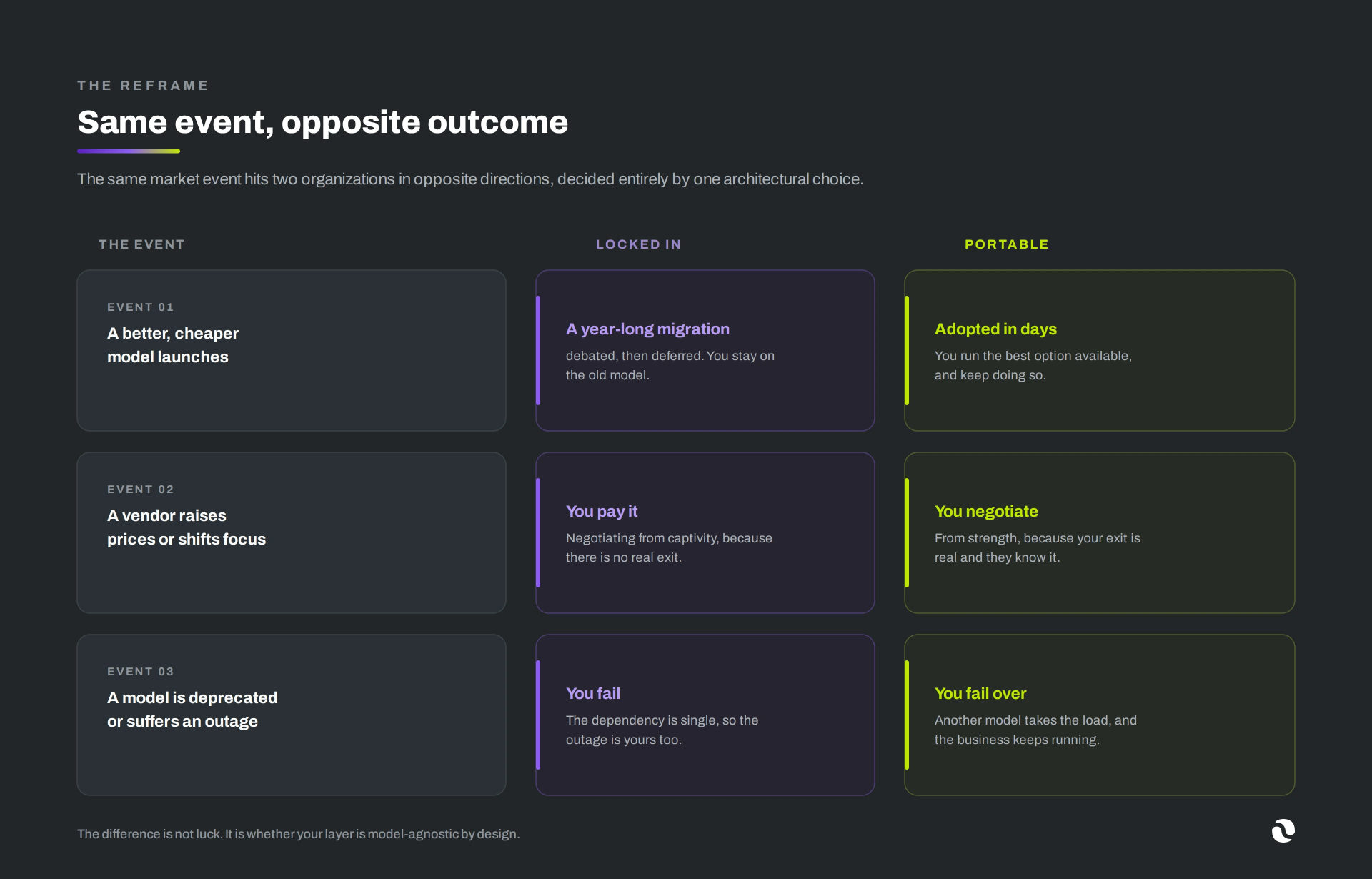
Consider what portability actually buys you. When a better or cheaper model launches next quarter, and one will, you adopt it in days rather than debating a year-long migration. When a vendor raises prices or shifts its roadmap away from your needs, you are negotiating from strength rather than from captivity, because your exit is real. When a model you depend on is deprecated or suffers an outage, you fail over instead of failing. Each of these is a downside for the locked-in organization and an upside for the portable one. Same market event, opposite outcome, decided entirely by an architectural choice you make now.
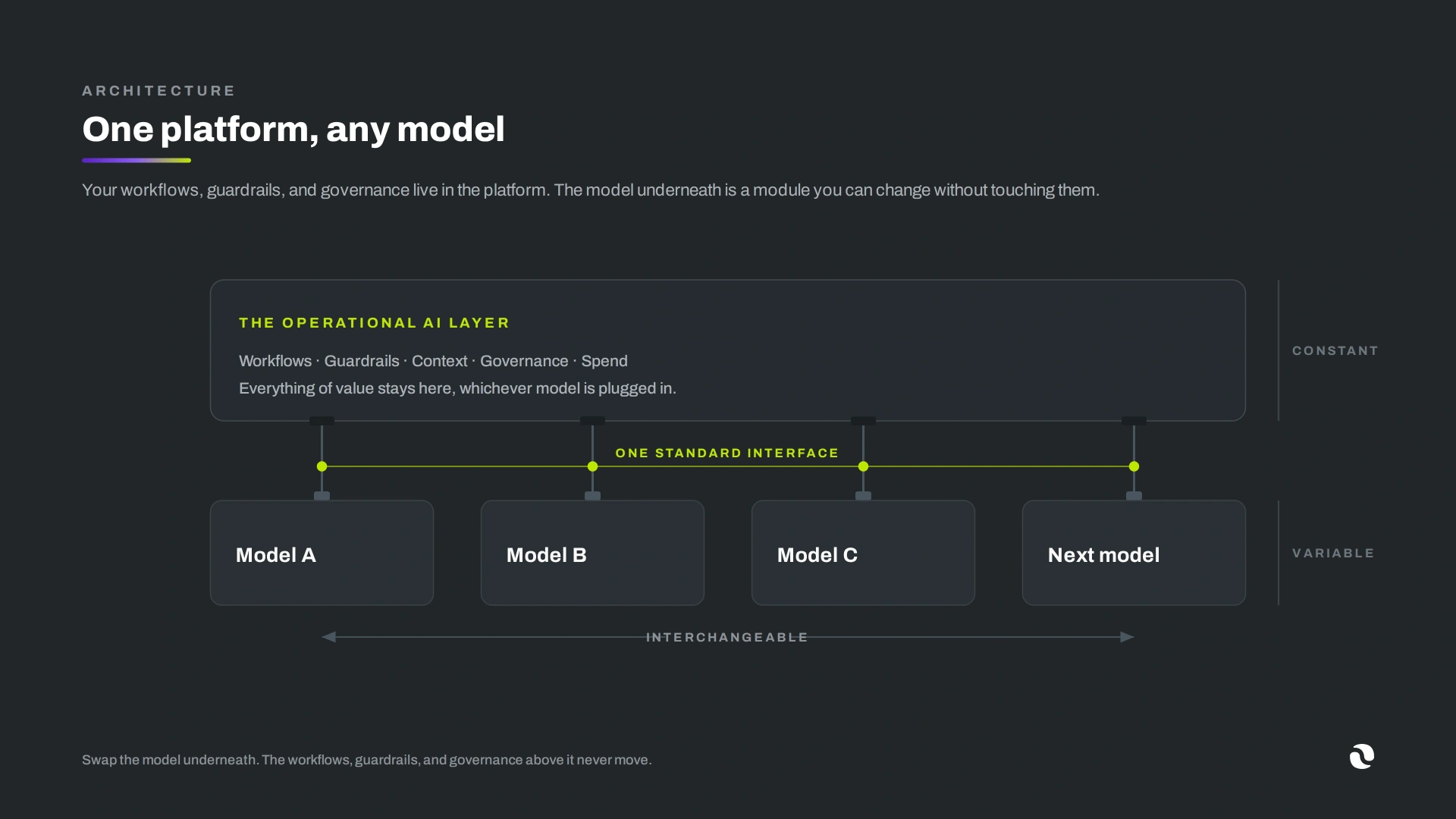
The principle is simple to state and hard to retrofit: the layer that coordinates your AI should be model-agnostic by design, so that the intelligence you build, your workflows, your guardrails, your accumulated knowledge, is yours and portable, served by whatever model is best at the time. The open standards emerging for connecting agents to tools and data, which the industry is increasingly building on to preserve interoperability across vendors, exist precisely to keep this freedom intact. Swap the model. Keep the business intact.
How to tell which kind of layer you have
You do not need a vendor's roadmap to assess your own exposure. You need to ask a few direct questions, and to be honest about the answers.
Could you move your workflows to a different platform without rebuilding them from scratch? If the answer is no, that is the sound of the cage.
Are your agent definitions, prompts, and guardrails expressed in an open or exportable form, or in a format that only this vendor can read? Ownership you cannot export is not ownership.
Could you change your primary model tomorrow without re-engineering everything above it? If the model and the orchestration are welded together, you have one dependency wearing the costume of two.
Is your flexibility a deliberate design choice, or simply where you happened to land? Most lock-in is not chosen. It is defaulted into, by adopting whatever was easiest first and discovering the cost only later.
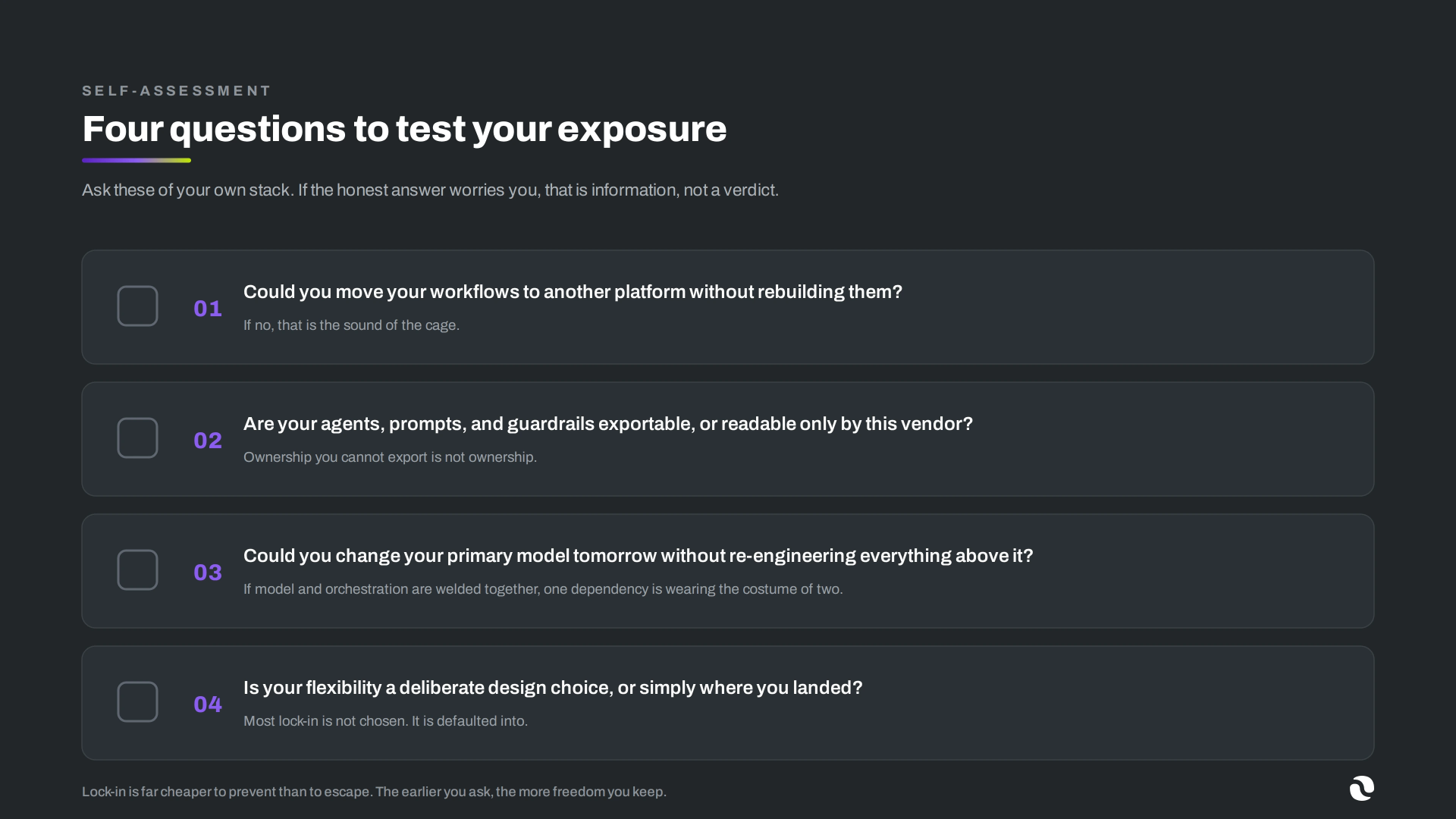
If those answers worry you, that is useful information, not a verdict. Lock-in is far cheaper to prevent than to escape, and the earlier you ask, the more freedom you still have to keep.
What to do now
You do not have to choose between control and freedom. The entire point of an operational layer done well is that you get both. A few moves protect the upside without slowing you down.
Insist on portability as a requirement, not a preference, when you evaluate any orchestration layer. Treat exportability of your workflows, agents, and guardrails as a hard line, the same way you would treat security or uptime.
Keep the intelligence you build separate from the model that runs it, so your accumulated workflows and knowledge never depend on a single provider remaining your provider.
Favor open standards for how your agents connect to tools and data, so interoperability is built in rather than bolted on later.
And protect optionality from the very first decision, because it is the cheapest thing to keep now and the most expensive thing to buy back once it is gone.
The bottom line
The organizations that win the next phase of enterprise AI will be the ones that gained control without surrendering their freedom. They coordinated their AI, governed every token, and built real institutional capability on top of it, all while keeping the ability to swap the model, change the vendor, and keep the business intact.
Control and lock-in are not the same thing, even though the market often sells them in the same box. The whole art is to take the one and refuse the other.
If you want to see what coordinated, governed, and genuinely model-agnostic looks like in one layer, you can Get started or Book a demo.