
Flow Templates
Reusable blueprints for flows — package a step sequence, instructions, assignments, and context once, then create consistent flows from them.
Creating, editing, and using flow templates depends on your organization's plan and the role permissions you have been granted, as well as the permissions set on the template itself and on each agent or resource its steps reference. Where you do not have access to a default agent or an attached resource, you see the note the template's author wrote for it instead. The access model is documented in one place: Access & Permissions.
Overview
A flow template is a reusable blueprint for creating flows. It captures a pre-configured flow — the sequence of steps, the instructions on each step, the assignments, the reviewers, the attached resources, and the flow-level context — so a new flow starts from a ready-made, multi-step setup instead of an empty workflow.
A flow is the most involved of Opal's ways of working: not one instruction, but an ordered process where every step has its own assignee, its own brief, and often its own review gate. Rebuilding that from scratch each time the process comes round is slow, and it is where consistency quietly slips — a step in a different order here, a review left off there. A template removes that risk. Someone who knows how the process should run lays it out once, and from then on whoever needs it fills in a few guided details rather than reconstructing the whole workflow.
A template holds the same elements as a flow, which means a process that already runs well can be captured as a template and reused every time it comes up. And every flow created from a template stays linked to it — so when the process improves, each flow can be brought up to date on its owner's schedule rather than rebuilt.
If flows themselves are new to you, read Flows first: this page assumes you know what steps, assignees, reviewers, and flow-level context are.
Key Capabilities
- Package a whole process. Capture the full step sequence, the step instructions, the assignments, the reviewers, the attached resources, and the flow-level context as a single reusable blueprint.
- Guide people with placeholders. Write the flow context, the step instructions, and the agent reviewer instructions as templated fields, using
{{ placeholders }}for the parts that change from one flow to the next, so the person creating the flow knows exactly what to supply. - Keep human-reviewer instructions readable. User reviewer instructions are standard text that is always readable, so a person asked to review a step can always see the full instructions they are expected to follow.
- Protect sensitive detail. Protect any of the three templated fields — flow context, step instructions, or agent reviewer instructions — when you would rather not expose those details to everyone who uses the template.
- Name a default agent, step by step. Select a default agent for a step's assignee or reviewer role, with an optional fallback note for anyone who does not have access to that agent.
- Ask for a person without naming one. User assignment is a simple toggle on a step rather than a named individual, so the template does not fix who that person will be.
- Equip the steps that need it. Attach knowledge, skills, connectors, tools, and guardrails within the template, so flows created from it start with the same context, capabilities, integrations, and controls.
- Say what to do when access is missing. Add a fallback note to any attached resource — knowledge, skills, connectors, tools, and guardrails — shown to anyone who lacks access to the underlying resource.
- Update on the owner's terms. Each flow stays linked to the template it came from, so its owner can choose to sync it with the template's latest updates when they are ready.
How it Works
A template is built once by an author, used many times by whoever creates flows, and stays connected to those flows afterwards.
1. An author defines the template. A flow template is built from the same elements that make up a flow: a sequence of steps with instructions, an assignee and optional reviewers for each step, any step-level resources, and the flow-level context that describes the flow's overarching goals and purpose.
- The step sequence. The order of the work is part of the blueprint. Laying the steps out in the template is what makes every flow created from it follow the same route, with the same checkpoints in the same places.
- Three fields that can carry placeholders. The flow context, the step instructions, and the agent reviewer instructions can each be written as templated fields using
{{ placeholders }}. Placeholders mark the parts that should change from one flow to the next — a client name, a plan tier, a delivery date — and the person creating the flow fills them in. Everything outside the placeholders stays the same in every flow created from the template, which is what makes the results consistent. - User reviewer instructions, always in plain sight. Instructions for a human reviewer work differently: they are not templated and cannot be protected, because a person being asked to review a step needs to read the full instructions for the review they are performing.
- Who does each step, and who checks it. For any step, the author can select a default agent for the assignee or reviewer role, and add a fallback note that appears if someone does not have access to that agent. Where a person should be involved, user assignment is set with a simple toggle on the step rather than by naming a specific individual. See Agents.
- The resources the work calls for. Knowledge, skills, connectors, tools, and guardrails can be attached within the template, so flows created from it start with the same context, capabilities, integrations, and controls. Each attached resource can carry its own fallback note for anyone who lacks access to it. See Knowledge Overview, Skills, Connectors, Tools, and Guardrails.
- Protection for anything that should stay private. Any of the three templated fields can be protected so its full contents stay hidden, while the template remains usable by everyone else.
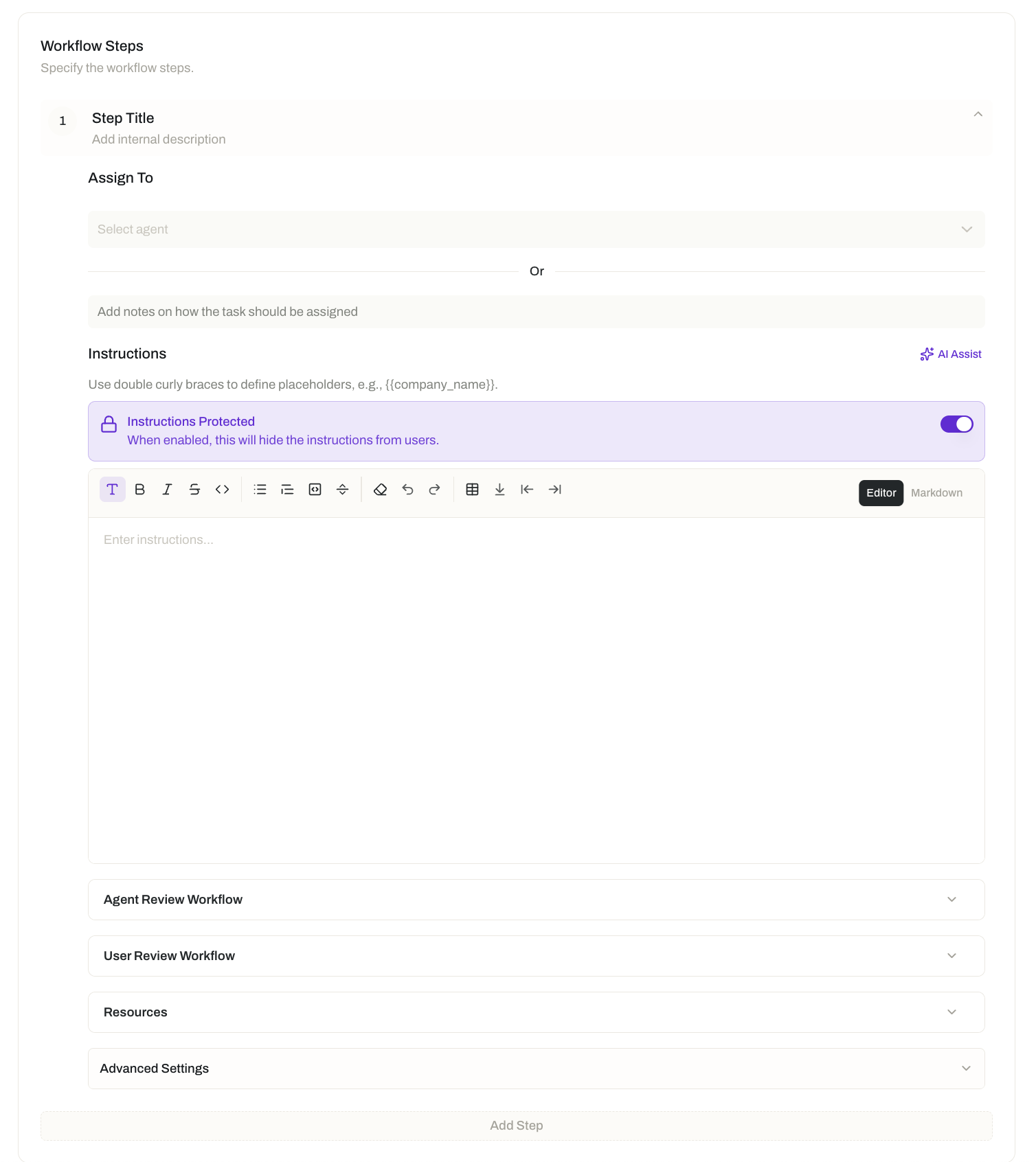
2. Someone creates a flow from the template. When creating a flow, a person can choose to start from a template instead of from scratch. The template pre-fills the flow's steps, assignments, resources, and context; the person fills in any placeholders and adjusts the flow as needed before running it.
- Fill in the placeholders. The placeholders in the flow context, the step instructions, and the agent reviewer instructions mark what needs to be supplied for this particular flow.
- Read what you need to act on. If a templated field is protected, its contents stay hidden — but the instructions for a human reviewer are always readable.
- Check what is missing. Where the creator does not have access to a step's default agent or an attached resource, the author's fallback note explains what to do or request instead.
3. Each flow stays linked to its template. When a template is updated, the flows created from it do not change automatically. Instead, each flow can be synced with the template's latest updates when its owner is ready — so an improved process spreads without a running flow shifting underneath the people relying on it.
Additional Notes
- The template is a starting point, not a cage. A flow created from a template is adjusted as needed before it runs, so a shared blueprint still leaves room for what is different about this particular run.
- Flows created from a template run in a space. The space provides the operational context, ownership, and access control around the flow. See Spaces.
- Protecting the process detail is what makes wide sharing comfortable. An author can distribute a template for reuse without exposing sensitive detail in the flow context, the step instructions, or the agent reviewer instructions — while the human reviewer's instructions stay readable, so nobody is asked to approve work they cannot see the brief for.
- Fallback notes prevent a dead end. Someone who cannot see a step's default agent or an attached resource gets the author's explanation at the moment they need it, instead of an unexplained gap in the setup.
- Templates are governed like other resources. Flow templates carry the platform's standard governance controls: version control, permissions, a publishing workflow, and an activity log. See Access & Permissions.
- The same idea applies to agents and tasks. See Agent Templates and Task Templates.
- Short definitions of the terms used here are in one place: Glossary.
{{ client_name }} and {{ plan_tier }}, and flow context describing the onboarding goals. A default agent is assigned to the data-migration step with a fallback note, and the final review step has the user reviewer toggle turned on with clear, always-readable instructions for the human approver. When a new customer signs on, a team member creates a flow from the template, fills in the placeholders for that client, and runs it — a consistent onboarding every time, without rebuilding the workflow. Each flow stays linked to the template, so when he refines the process and updates the template, each client's flow is synced to the latest version on its own schedule.Related Features
- Flows — What a flow is and how one is built; a flow created from a template inherits the template's steps, instructions, assignments, reviewers, resources, and context, stays linked to it, and can then be adjusted. Flows
- Agents — The digital workers a template can name as a step's default assignee or reviewer, with a fallback note for anyone who lacks access to them. Agents
- Spaces — The operational environment a flow created from a template runs in, providing its context, ownership, and access control. Spaces
- Knowledge Overview — Organizational knowledge a template can attach, so flows created from it start with the same context. Knowledge Overview
- Skills — Packaged expertise a template can attach, so flows created from it follow the same method. Skills
- Connectors — Secure links to external systems a template can attach, so flows created from it reach the same systems. Connectors
- Tools — Callable actions a template can attach, so flows created from it can take the same actions. Tools
- Guardrails — Input and output safeguards a template can attach, so flows created from it run with the same controls. Guardrails
- Agent Templates — The same blueprint model applied to agents. Agent Templates
- Task Templates — The same blueprint model applied to tasks. Task Templates
- Access & Permissions — The full access model behind plans, role permissions, and per-resource permissions. Access & Permissions